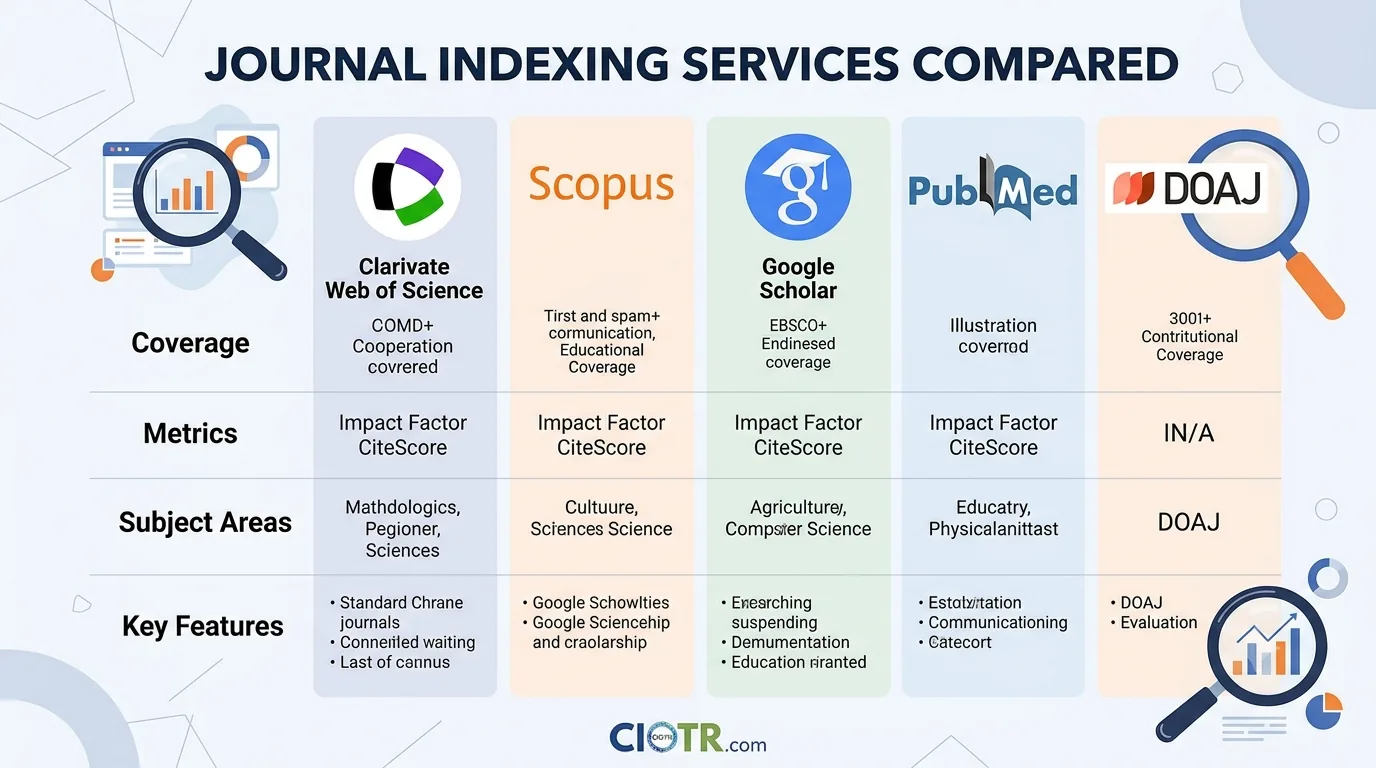
For a young journal, getting indexed is often the difference between an article that gets read and one that disappears. But "indexing" is not one thing — it covers everything from a fully automated crawler like Google Scholar to a rigorously curated, application-only database like Web of Science. Each service has its own scope, cost, and turnaround time, and applying to the wrong one first can cost a journal months. Here is how the major services actually compare.
Google Scholar
Google Scholar is not a curated index in the traditional sense — there is no application form and no editorial committee. Instead, its crawler discovers articles automatically from journal websites that expose the right metadata (the citation_* meta tags most journal platforms, including ours, generate on every article page). Coverage is broad and free, which makes it the fastest way for a new journal to become discoverable, but it is also the least controllable: there is no manual "submit my journal" option, and a page that is missing the right tags simply will not surface complete citation data, regardless of how good the article is.
Best for: immediate, no-cost visibility for every article, especially early in a journal's life before it qualifies for anything more selective.
DOAJ (Directory of Open Access Journals)
DOAJ is the standard reference point for open-access journals specifically. It runs a genuine editorial review — checking for a real editorial board, a public peer-review policy, ISSN registration, and transparent publication ethics — and it publishes its criteria in full, which makes it a realistic first target for a new, legitimately-run open-access title. Inclusion is free. Review typically takes a few months, and DOAJ has become noticeably stricter in recent years in response to predatory-journal abuse, so applications with thin editorial information are routinely rejected.
Best for: open-access journals that want a credible, widely-recognised stamp of legitimacy without a subscription fee.
Scopus
Scopus, maintained by Elsevier, is one of the two dominant citation databases used for research evaluation, alongside Web of Science. Its Content Selection and Advisory Board reviews journals against criteria that include editorial rigour, publication regularity, international diversity of authorship, and citation impact — which in practice means a journal usually needs two to three years of consistent publishing history before it stands a realistic chance. Rejection is common on a first application, and re-application windows are typically a year apart.
Best for: established journals aiming for a Scopus CiteScore, which many universities use directly in hiring, promotion, and funding decisions.
Web of Science (Clarivate)
Web of Science evaluates on similar lines to Scopus but is generally regarded as the more conservative of the two, particularly for its flagship Science Citation Index Expanded and Social Sciences Citation Index. It places heavy weight on citation impact and international editorial representation, which again tends to rule out very young journals. Clarivate also maintains the Emerging Sources Citation Index, a lower entry-barrier tier that indexes a journal without yet assigning it a full Impact Factor — a common and sensible stepping stone.
Best for: journals with an established track record, or as a longer-term goal reached via the Emerging Sources Citation Index first.
EBSCO and ProQuest
EBSCO and ProQuest are large aggregator databases that university libraries subscribe to directly, rather than public, freely searchable indexes. Being listed here matters mainly because it puts a journal's articles in front of readers browsing through their institution's library system, which is how a large share of academic reading actually happens. Application requirements are comparatively modest, and many subject-specific or regional journals are accepted here well before they qualify for Scopus or Web of Science.
Best for: reaching readers through university library systems, and as a credible middle step before pursuing the larger citation databases.
Crossref
Crossref is not an index in the discovery sense — it is the DOI registration agency that most journals use, and it is what makes a citation like https://doi.org/10.xxxx/xxxxx resolve to the right article permanently. Registering with Crossref is close to a prerequisite for being taken seriously by every other service on this list, since it also feeds citation-linking data that Scopus, Web of Science, and Google Scholar all rely on.
Best for: every journal, from day one — it underpins the credibility signals the other services check for.
The CIOTR Journal Index (CJI)
We built CJI for exactly the gap this list exposes: the long stretch between "just launched" and "old enough for Scopus." Applications are free, reviewed against published criteria — a valid ISSN, a working editorial board, a documented peer-review policy, and regular publication — and decided within two to four weeks, with a reason given either way. A rejected journal is told specifically what to fix and is welcome to reapply once it has. It will not replace Scopus or Web of Science for research-evaluation purposes, but it gives a young, legitimately-run journal a verifiable, linkable listing while it builds the track record the larger databases require.
How to sequence your applications
In practice, most journals benefit from working through these roughly in order of entry barrier rather than applying everywhere at once:
- Register with Crossref immediately, so every article has a resolvable DOI from day one.
- Make sure your platform emits correct
citation_*metadata so Google Scholar can index every article automatically, at no cost and with no application. - Apply to the CIOTR Journal Index and DOAJ once you have a few published issues, a public editorial board, and a documented peer-review process — both are free and both are realistic for a young journal.
- Pursue EBSCO or ProQuest listing to reach readers through university libraries as your publication history grows.
- Aim for the Emerging Sources Citation Index, then Scopus and full Web of Science coverage, once you have two or three years of consistent, on-schedule publishing behind you.
If your journal meets the basics — a real ISSN, a named editorial board, and a published peer-review policy — the fastest credible step you can take today is a free application to the CIOTR Journal Index.