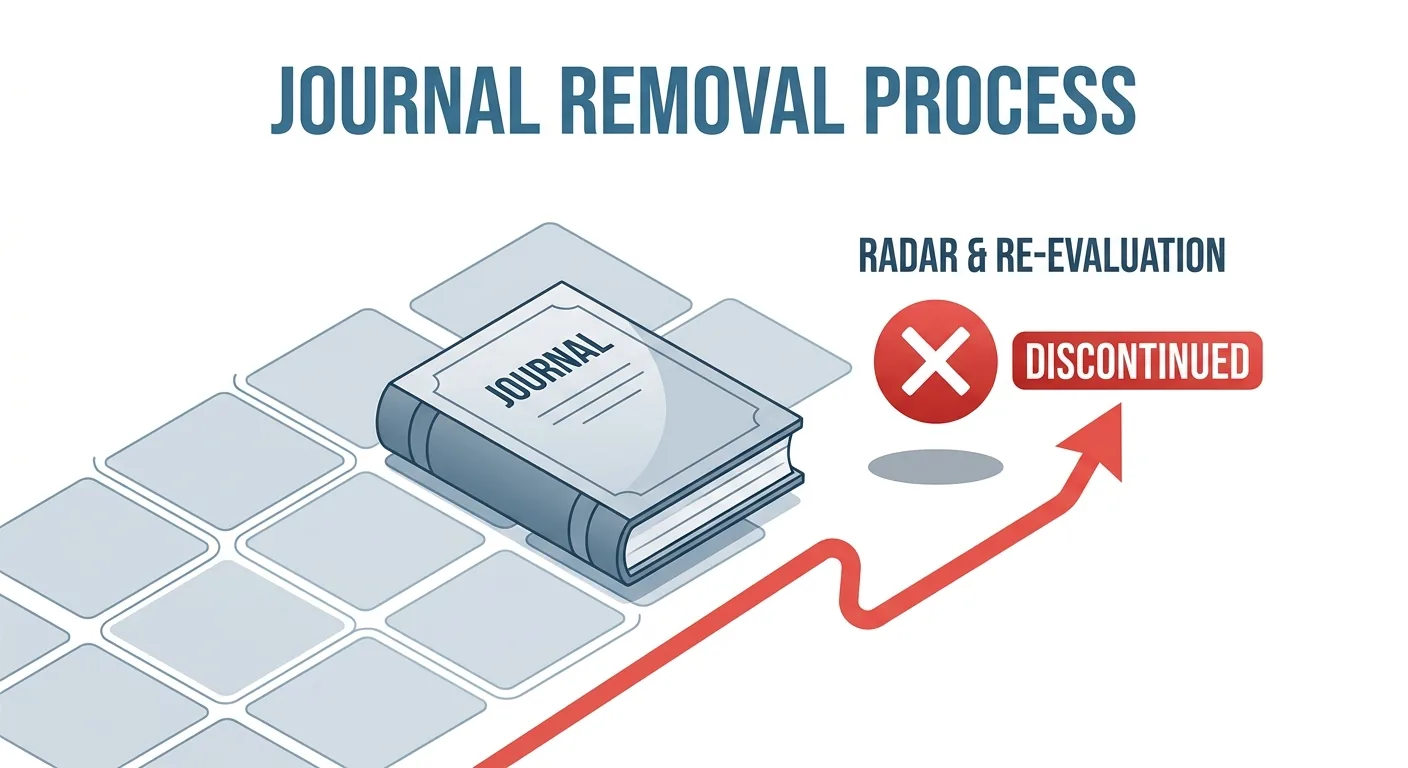
Almost everything written about Scopus treats indexation as a finish line. Pass the review, get the badge, put it on the homepage. The part that gets far less attention is that Elsevier keeps evaluating your journal for as long as it stays indexed, that an algorithm has been scanning every title in the database since 2017, and that anyone in the research community can report your journal directly. When either of those fires, the Content Selection & Advisory Board re-runs the same evaluation you passed to get in.
Most editors find this out the way you would rather not: when it happens to them. Here is how the mechanism actually works, what sets it off, and what it costs.
Indexation is a status, not a credential
This is the framing that matters, and it is the one most journals get wrong. A degree, once awarded, is yours. Scopus coverage is closer to a licence: conditional, reviewed, and revocable. Elsevier's own wording is that selected journals are covered "on a continuous basis" but that "the performance of journals included in Scopus is being evaluated continuously and poor performing journals may be discontinued."
If you are still working out what the status itself means and what it does not, we covered that separately in what "Scopus indexed" actually means. This post is about the other direction: losing it.
How a title gets flagged
Elsevier's content policy and selection page documents two routes into re-evaluation, and they behave quite differently.
- Publication concerns. Elsevier states that "concerns about the publication standards of a journal indexed in Scopus can be raised by the research community." This is a human route. A reader, a rival editor, a sleuth working through image duplications, an author who had a bad experience. Anyone can start it.
- Outlier performance. Elsevier's data scientists run automated detection for "outlier or unexpected publishing performance," looking at "unexpected patterns in publication activities, citation graphs, author collaborations, or content."
Separately, Elsevier's editor-facing material describes titles being flagged for underperformance against metrics and benchmarks set by the CSAB, and through analysis of feedback from earlier CSAB evaluations. So in practice there are more than two doors, but the two above are the ones documented in the content policy itself.
Radar: what the algorithm is looking for
The automated route has a name. Radar is a data-analytics model built by Elsevier's data scientists and running since 2017. It scans indexed titles on a recurring cycle, and it is not looking for bad research. It is looking for shapes that do not occur naturally.
That distinction is worth sitting with, because it explains why journals get flagged for things nobody involved considers misconduct:
- Publication volume that jumps. A journal that publishes 60 articles a year and then 400 has changed into a different journal. The model does not care why.
- Citation graph anomalies. Self-citation is the obvious one. Elsevier notes that where self-citations suddenly exceed certain levels, the CSAB may consider a title for re-evaluation and temporary inactive status. Reciprocal citation between a small cluster of journals is the less obvious one.
- Author collaboration patterns. Sudden concentration of authorship in one country or one network, where the journal previously drew broadly.
- Content drift. Published work moving away from the stated aims and scope.
A special issue programme that runs hot for two years will produce every one of these signals at once. So will a journal that gets popular quickly for entirely legitimate reasons. The model flags the pattern and hands it to humans, which is the right design, but it does mean growth and manipulation can look similar from the outside.
The detail most editors miss
Here is the line in Elsevier's policy that deserves more attention than it gets: during re-evaluation, "the content flow for these titles will be suspended until the re-evaluation is complete."
Your journal is not delisted. It has not been found guilty of anything. But new articles stop being added to Scopus while the board works, and the board works on its own schedule. Authors who submitted to you specifically because you were indexed will publish into a gap. You will find out about it from them.
Elsevier's Researcher Academy material on tracking journal performance indicates that Radar and publication-concern cases enter the pipeline immediately, without a warning period. The suspension is the first thing many editors notice.
Re-evaluation applies the same criteria you already passed
There is no separate, gentler standard for incumbents. Elsevier is explicit that the CSAB applies "review criteria identical to the Scopus content selection criteria for newly suggested titles."
That means the full set: the five categories and the 14 individual criteria, scored again from scratch. Editorial concept, peer-review type, geographic diversity of editors and of authors, academic contribution, clarity of abstracts, conformity with aims and scope, readability, citedness in Scopus, editor standing, schedule adherence, online availability, English home page, home page quality. We broke each of those down in the Scopus indexation criteria post, and that breakdown is as useful for defending coverage as for winning it.
The uncomfortable implication: a journal that was accepted in 2019 and has coasted since is being measured against what the CSAB expects in 2026, not against its own past self.
Two outcomes
The board decides either to continue coverage or, in Elsevier's phrasing, "to discontinue the forward flow of the journal's coverage in Scopus."
That phrase is precise and worth reading carefully. Discontinuation stops what comes next. It does not erase what came before.
What happens to work you already published
This is the question every editor asks first, and the answer is better than most expect.
Articles already indexed stay indexed. Elsevier keeps them "as a matter of scientific record and to ensure the stability and consistency of research trend analytics." Your authors' existing papers remain in Scopus, remain citable, and keep contributing to their profiles. Nobody's CV gets rewritten.
There is one exception, and it is narrow: "in exceptional cases of proven and severe unethical publication practice, content already indexed in Scopus may be removed." Proven and severe. Not disputed, not suspected.
What stops is everything after the discontinuation date. Those articles are not added, do not accrue Scopus-visible citations, and do not count toward the journal's metrics. For authors, the practical effect is that publishing with you no longer delivers the thing many of them came for.
After discontinuation: the embargo
A discontinued title cannot simply reapply once the problem is fixed. Elsevier states that "in case of discontinuation, there will be an embargo period during which the title cannot be suggested again," and for titles removed through re-evaluation that period is five years.
Five years is the top of the ladder. A journal rejected on first application receives an embargo of 6 months, 1, 2, 3, or 5 years depending on how long reviewers think the fix will take. Losing coverage you already held goes straight to the maximum.
Worth doing that arithmetic honestly. A journal discontinued in 2026 is applying again in 2031, and arriving as a title with a discontinuation on its record.
What actually sets this off
Patterns that recur across discontinued titles, in rough order of how often they appear:
| Trigger | What it usually looks like from inside the journal |
|---|---|
| Self-citation inflation | An editor "suggesting" relevant prior work from the journal during review. Often well-intentioned, and one of the fastest routes to a flag. |
| Volume spikes | A guest-edited special issue programme that scales faster than the editorial capacity reviewing it. |
| Peer review decay | Review times shortening while acceptance rates climb. Usually a symptom of reviewer fatigue, not of intent. |
| Scope drift | Accepting adjacent-field submissions to fill issues, until the published content stops matching the aims and scope. |
| Schedule slippage | A quarterly journal quietly becoming a roughly-quarterly one. Regularity is a scored criterion at re-evaluation exactly as it is at selection. |
| Ethics complaints | Unresolved authorship disputes, image duplication reports, or retraction requests left unanswered. The complaint route needs one motivated person. |
Notice how few of these require anyone to behave badly. Most are what a stretched editorial team looks like after a growth year.
What to watch, and how often
Radar runs on a recurring cycle whether or not you are paying attention, so the useful move is to monitor the same things it does. A quarterly hour is enough:
- Your self-citation rate. Calculate it. If it is drifting upward year on year, find out where in your workflow that is coming from before Elsevier does.
- Output against the previous year. Not whether it grew, but whether the shape of the growth is explicable in a sentence.
- Author geography. Concentration is a scored criterion on the way in and a flag on the way out.
- Acceptance rate against review time. If one is rising while the other falls, that is the signal you can act on earliest.
- Your open complaints. Anything unresolved is somebody's motivation to use the publication-concerns route. COPE flowcharts exist for most of these situations; following one and documenting it is the defence.
None of this is exotic. It is the same evidence the CSAB looks at, checked by you first.
The honest summary
Scopus discontinuation is rarely a verdict on a journal's research. It is usually a verdict on a journal's operations, and it tends to arrive after a period the editors would describe as a good year. Growth, a big special issue, a surge of submissions from one region, a schedule that slipped while everyone was busy.
The defence is unglamorous: know your own numbers, hold your schedule, keep the board and the author base genuinely international, and answer complaints in writing. The same discipline that earns coverage is the discipline that keeps it, which is convenient, because it means there is only one thing to get right.
If you are earlier in this journey and Scopus is still ahead of you rather than behind, start with how to get a journal indexed in Scopus, and see how the major indexing services compare for what is realistic in what order. The CIOTR Journal Index checks a similar set of operational fundamentals on a much shorter cycle, and applications are free and reviewed in two to four weeks, which makes it a reasonable way to find out how your journal reads to an external reviewer while the stakes are still low.