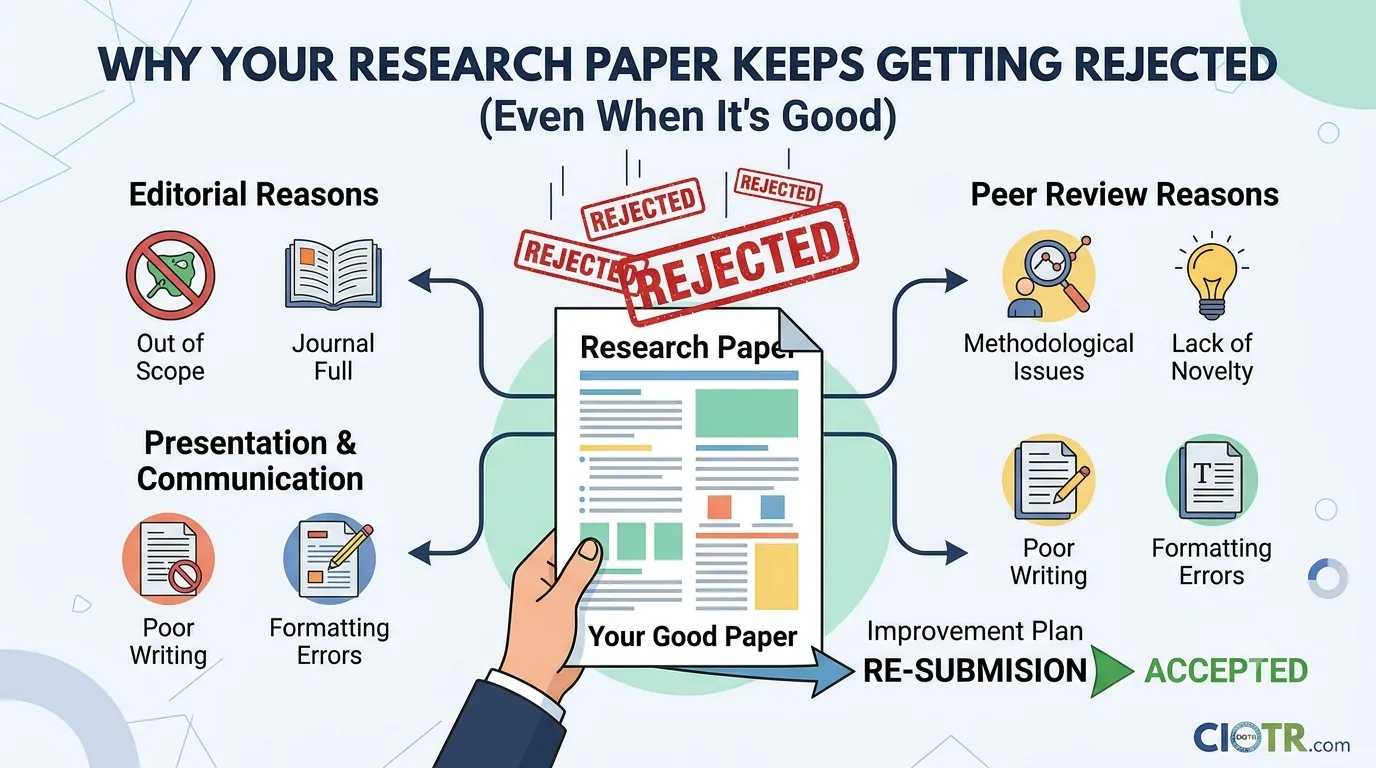
Almost every researcher has felt this: a manuscript you are genuinely proud of, built on real data and honest effort, comes back rejected — sometimes more than once, sometimes from journals that seem like an obvious fit. It is rarely because the underlying research is worthless. In editorial experience, the same handful of fixable problems account for most repeat rejections, and they are almost never the ones authors suspect.
1. The journal was never the right fit
The single most common cause of desk rejection has nothing to do with quality — it is scope mismatch. Editors reject strong papers in minutes when the topic, methodology, or audience does not match the journal's actual readership, regardless of how well the paper is written. Before submitting, read five recent articles from the target journal, not just its aims-and-scope page. If your paper would look out of place next to them, it will be rejected regardless of its merit.
2. The contribution isn't stated — it's assumed
Authors who live inside their own research often forget that reviewers do not. A paper can contain a genuinely novel contribution and still get rejected because the introduction never states, in one clear sentence, what is new and why it matters. "We study X" is not a contribution statement. "Prior work assumed Y; we show that Y fails under Z, which changes how practitioners should approach W" is. If a reviewer has to infer your contribution from the results section, you have already lost most of them.
3. The literature review defends the wrong thing
A weak literature review does not just mean missing citations — it usually means the paper fails to position itself against the two or three closest competing works. Reviewers who know the field will immediately ask "how is this different from [the obvious prior paper]?" If your related-work section does not pre-empt that question directly, a reviewer will raise it as a rejection-grade concern rather than a minor revision.
4. Methodological rigor doesn't match the claim being made
The scope of a claim has to match the strength of the evidence behind it. A small-sample pilot study framed as a general, field-wide finding will be rejected on methodological grounds even if every individual step was executed correctly — because the conclusion overreaches the data. Common flags reviewers raise: insufficient sample size or statistical power, missing baseline comparisons, no discussion of confounds, or results that are not reproducible from the description given. Match your claims to what your method can actually support, and be explicit about it.
5. The writing hides the result instead of revealing it
Reviewers are volunteers reading dozens of manuscripts on top of their own work. An abstract that buries the actual finding under three sentences of background, or a results section that reports numbers without stating what they mean, gets misread — and misread papers get rejected for reasons that have nothing to do with the science. State the finding plainly in the first two sentences of the abstract, and interpret every key number the moment you present it.
6. Guideline non-compliance triggers an automatic desk rejection
Word limits, reference formatting, blinding requirements for double-anonymous review, missing ethics statements, missing data-availability statements — these look like paperwork, but at most journals they are checked before a human ever reads the science. A paper that violates author guidelines is often rejected without full review purely on that basis, then resubmitted unchanged to the next journal, where it fails again for the same reason. Five minutes against the checklist prevents this entirely.
7. Limitations are absent or defensive
Every method has boundaries. Reviewers do not penalise authors for acknowledging them — they penalise papers that pretend the boundaries do not exist, because it signals the authors either did not notice the limitation or are hoping the reviewer won't. A clear, specific limitations section (not a vague closing paragraph) reads as rigor, not weakness, and pre-empts exactly the objection that would otherwise become a rejection.
8. The same manuscript is resubmitted unchanged
When a paper is rejected, the reviewer comments are free diagnostic information — and the single most damaging pattern is submitting the same manuscript to journal after journal without addressing what previous reviewers actually flagged. If three different journals raised similar concerns about the methodology or framing, that is not bad luck; it is the same real issue seen by three independent readers. Revise before resubmitting, even to a different journal.
What to do next
If your manuscript has been rejected more than once, work through this list in order before changing anything else: confirm journal fit, sharpen the contribution statement to one sentence, check that your related-work section directly addresses the closest competing papers, make sure your claims match your evidence, and read the target journal's author guidelines line by line. Most "the reviewers didn't get it" rejections are, on close inspection, one of these eight issues wearing a different disguise.
If you are looking for a venue with a transparent, constructive peer-review process for revised work, the Journal of Smart Computing publishes open-access research in AI, machine learning, and intelligent systems, and reviewers are asked to give specific, actionable feedback rather than a bare accept or reject. And once your journal itself is ready to build its own track record, our piece on how the major indexing services compare and our guide to getting indexed in Scopus cover what comes after publication.