Ask three researchers what the difference is between SCI, SCIE, SSCI and ESCI and you will get three answers, at least one of which was true in 2019 and is wrong now. The confusion is understandable: Clarivate renamed things, retired things, and in the last two years changed the rules in a way that undid the single fact most people had memorised about ESCI.
So here is the current position, checked against Clarivate's own documentation rather than the advice circulating on forums.
What the Web of Science Core Collection actually contains
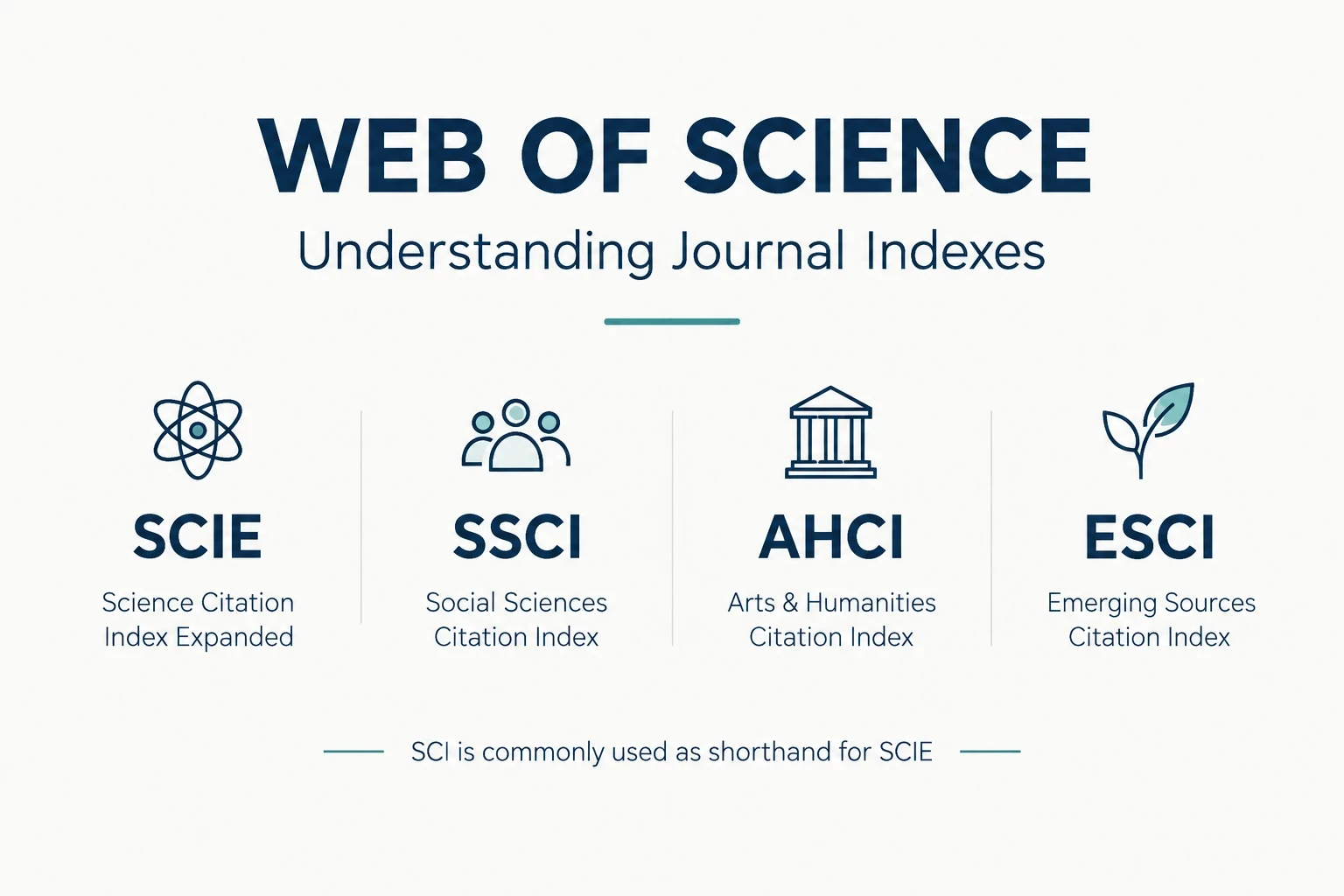
The Core Collection is not one index. It is a set of them, and a journal is indexed in exactly one of the four journal editions:
| Index | Full name | Covers |
|---|---|---|
| SCIE | Science Citation Index Expanded | The sciences, from engineering and computing to medicine. |
| SSCI | Social Sciences Citation Index | Economics, management, psychology, education and related fields. |
| AHCI | Arts & Humanities Citation Index | History, literature, philosophy, the arts. |
| ESCI | Emerging Sources Citation Index | All subjects. The entry point to the Core Collection. |
Alongside those sit the Conference Proceedings Citation Index and the Book Citation Index, which cover conference papers and scholarly books rather than journals.
Notice what is missing from that list: SCI.
SCI and SCIE are not two different things
This is the question that comes up most, and the answer is simpler than people expect.
The Science Citation Index launched in 1964 as Eugene Garfield's printed index at the Institute for Scientific Information. It was selective by necessity, because it was a physical product. When it moved online in 1997 the expanded version took over, and that is the Science Citation Index Expanded we have today.
There is no separate "SCI" edition in the Core Collection now. When a colleague, a funder or a promotion committee says "SCI journal", they mean a journal in SCIE. The term survives as shorthand, and in some national evaluation systems it is still written into the rules, which keeps it alive long after the product stopped existing. If someone asks whether your paper is in SCI or SCIE, they are asking the same question twice.
How a journal lands in one index rather than another
Clarivate evaluates every journal against 28 criteria, split into two groups that do different jobs.
- 24 quality criteria. Editorial rigour and publishing practice: a real editorial board, a described peer-review process, ethics policies, publishing on schedule, clear identification, English-language titles and abstracts. These are the entry gate.
- 4 impact criteria. Citation performance, judged against other journals in the same subject category.
Meeting the quality criteria gets a journal into ESCI. Meeting the impact criteria as well moves it into SCIE, SSCI or AHCI, whichever matches its subject. The editions are not separate applications and there is no form to pick one.
Worth knowing, because it changes what a new journal should aim for: Clarivate currently evaluates all new submissions against the 24 quality criteria only, and journals selected for coverage are added to ESCI. Impact is assessed later, when a small cohort of high-performing titles is reviewed after each Journal Citation Reports release. For a journal applying today, ESCI is not a consolation prize. It is the only door.
The part that is now out of date everywhere
For years the defining fact about ESCI was that it carried no Journal Impact Factor. Entire blog posts, library guides and institutional policies were built on that distinction. It stopped being true in 2023.
- 2023: Clarivate extended the Journal Impact Factor to AHCI and ESCI journals. Around 9,000 journals received a JIF for the first time. They did not yet receive category rankings or quartiles.
- 2024: ESCI and AHCI journals entered the subject category rankings. More than 7,200 journals gained rankings, roughly 7,000 of them from ESCI. Each subject category now has a single unified ranking covering every edition, so a category such as Psychiatry ranks its SCIE, SSCI and ESCI journals together.
So an ESCI journal today can have both an Impact Factor and a quartile. Anyone still telling you that ESCI means "no Impact Factor" is working from pre-2023 information.
One exception is easy to trip over: the 25 arts and humanities specific categories do not receive a rank, quartile or percentile. AHCI journals were folded into the shared science and social science categories, but the arts-only categories stayed unranked.
A second thing worth knowing before you quote a quartile at anyone: a journal assigned to more than one subject category gets a separate rank in each, so the same title can be Q1 in a small category and Q3 in a large one. Both numbers are correct. Journals advertise the flattering one, which is not dishonest, but it does mean a bare "Q1" on a call for papers tells you less than it appears to.
Does that make ESCI equivalent to SCIE?
No, and it is worth being straight about why.
ESCI journals are in the Web of Science Core Collection. Their articles are indexed, their citations count, they appear in searches, and they now carry metrics. That is real, and it is a meaningful step above being in no selective index at all.
But the editions still mean different things. SCIE and SSCI membership says a journal cleared the impact bar; ESCI membership says it cleared the quality bar and has not yet cleared the other one. Clarivate's own figures from the 2024 rankings make the pattern visible: journals from SCIE, SSCI and AHCI cluster in the higher quartiles, while most ESCI journals land in the lower ones. Adding roughly 7,000 journals to the rankings also enlarged the categories themselves, with SSCI categories growing by about 85% on average and SCIE categories by about 30%, which quietly moved existing journals down the table without anything about them changing.
The practical consequence for authors is institutional rather than technical. Plenty of universities, funders and national systems still write their rules in terms of SCIE and SSCI, and a Q2 in a newly ranked ESCI category may not be read the same way as a Q2 in SCIE. Before you submit, check what your own institution counts. That is a policy question, not a bibliometric one, and the answer differs by country and sometimes by department.
Movement runs in both directions
The editions are not permanent addresses.
An ESCI journal whose citation performance improves can be promoted into SCIE, SSCI or AHCI. A journal already in those indexes whose impact declines can be moved back down to ESCI. And any journal that stops meeting the 24 quality criteria can be removed from the Core Collection altogether under Clarivate's removal policy, which is a different and more serious outcome than being demoted.
That last point matters for editors more than authors. Quality criteria are the floor you stand on, not a hurdle you clear once. If this sounds familiar, it is the same logic Scopus applies through its re-evaluation programme, which we covered in how journals get removed from Scopus.
How to check which index a journal is in
Do not rely on the journal's own website. A publisher claiming to be "Web of Science indexed" may be in ESCI, in the Conference Proceedings index, or in a non-Core database such as the Zoological Record, and all three get advertised with the same phrase.
Check it yourself, in this order:
- Search the Master Journal List by title or ISSN. It is free and it names the exact editions a journal belongs to.
- Read the edition names carefully. "Web of Science Core Collection: Emerging Sources Citation Index" and "Web of Science Core Collection: Science Citation Index Expanded" are very different claims presented in nearly identical wording.
- If a metric matters to you, check the Journal Citation Reports entry rather than a figure quoted on the journal's homepage. An Impact Factor shown without a year, or described as a "general impact factor" or "global impact factor", is usually from an unrelated commercial service with no connection to Clarivate.
That third one catches a surprising number of people. Fake metrics borrow the vocabulary of real ones precisely because the vocabulary is confusing.
What this means if you are choosing where to submit
For most authors the ranking of concerns goes: does my institution count this index, is the journal's scope a genuine fit, and only then what quartile it sits in. A well-matched ESCI journal that your department recognises will serve your career better than a poorly matched SCIE journal that desk-rejects you after four months.
For editors building a journal, the sequence is fixed and there is no way around it. Meet the 24 quality criteria, get into ESCI, publish consistently for several years, and let citations accumulate until the impact criteria are within reach. The quality criteria are the part you fully control, and they are mostly operational: a documented peer-review process, a real and diverse editorial board, a schedule you actually keep, and ethics policies you apply.
If you are weighing Web of Science against the alternatives, our comparison of the major indexing services sets out what each one requires and in what order they become realistic. Scopus runs a parallel process with its own criteria, which we broke down in the Scopus indexation criteria post, and the meaning of "Scopus indexed" suffers from much the same confusion this article is trying to clear up for Web of Science.
The CIOTR Journal Index reviews on a far shorter cycle than either, checking the same operational fundamentals that both Clarivate and Elsevier assess first: a registered ISSN, a named editorial board with verifiable affiliations, and a documented peer-review policy. Applications are free and reviewed in two to four weeks, with a reason given either way, which makes it a reasonable way to find out how your journal reads to an external reviewer before you spend a year waiting on a bigger one.